

Table of Contents
- Why Cheap Hoodies Fail in the Garage
- Quick Comparison: BNF Motorworks Hoodies at a Glance
- Best Fabric for Mechanic Hoodies: GSM, Blends, and Abrasion Resistance
- How to Choose Workwear Hoodies for Cold Garages
- Durable Hoodies for Garage Work: Reinforced Stress Points and Pocket Utility
- Safety Standards: Flame-Resistant and Hi-Vis Requirements for Technicians
- Layering Systems and Care for Heavy-Duty Hoodies
- Where to Buy Heavy Duty Mechanic Hoodies: Pricing and Bulk Orders
- Frequently Asked Questions
Last Updated: October 4, 2026
Why Cheap Hoodies Fail in the Garage
Most budget hoodies are built for a commute, not a garage floor: thin single-stitch seams, low-gauge cotton, and prints that crack after two cold washes. Heavy duty mechanic hoodies cost more because you pay for fabric weight, reinforced construction, and ink that survives grease, coolant, and friction.
DIY mechanics and technicians often find that a cheap hoodie felt fine in the store, then pills, stretches, and fades within a month of real work. That is a construction problem, not bad luck.
This guide covers fabric weight, fit, safety standards, layering, and where to buy, so you spend once instead of three times.
Quick Comparison: BNF Motorworks Hoodies at a Glance
Every hoodie below uses the same core blank, the Gildan 18500 Heavy Blend, so the difference is artwork, not build quality.
| Hoodie | Price | Fabric | Best For |
|---|---|---|---|
| Turbo Skull Back (Black) | $47.99 | 50/50 cotton-poly, 271 g/m² | Everyday garage wear |
| Skeleton Mechanic Back | $47.99 | 50/50 cotton-poly, 271 g/m² | Car show statement piece |
| Classic Sharknose Skull Back | $47.99 | 50/50 cotton-poly, 271 g/m² | Motorcycle riders |
| Engine Breaker Back Print | $59.99 | 50/50 cotton-poly, 271 g/m² | Bold back-print fans |
| Sledge Piston Back (Black) | $47.99 | 50/50 cotton-poly, 271 g/m² | Cold-weather layering |
Best Fabric for Mechanic Hoodies: GSM, Blends, and Abrasion Resistance
The best fabric for mechanic hoodies is a medium-heavy cotton-polyester blend around 271 g/m², balancing warmth, abrasion resistance, and breathability without turning stiff.

GSM (grams per square meter) is the clearest signal of how a hoodie will hold up. Below roughly 200 g/m², fabric feels flimsy and pills fast; above 400 g/m², movement gets restricted.
Why 271 g/m² (8 oz) Heavy Blend Hits the Sweet Spot
271 g/m² (8 oz) is the practical middle ground for garage work: heavy enough to resist snags on sharp edges, light enough to keep your range of motion.
The 50/50 cotton-poly mix matters too: cotton adds breathability and softness, polyester adds shape retention and moisture-wicking. Pure cotton stays damp with sweat; pure synthetic feels clammy.
How to Choose Workwear Hoodies for Cold Garages
To choose workwear hoodies for cold garages, prioritize fit and range of motion, then layering, then hard hat compatibility if required.
A hoodie that fits like a fashion piece binds at the shoulders when you reach over an engine bay. Look for a classic unisex cut with ribbed cuffs and hem, which hold shape and stop cold air creeping up your wrists.
Fit, Range of Motion, and Hard Hat Compatibility
- Shoulders: Raise both arms overhead. If the hem lifts past your waist, size up.
- Sleeves: Ribbed cuffs should sit at the wrist, not ride up when you reach.
- Hood: A double-lined hood with a matching drawcord holds shape and fits under a hard hat without bunching.
Durable Hoodies for Garage Work: Reinforced Stress Points and Pocket Utility
Durable hoodies for garage work share three traits: reinforced stress points, abrasion-resistant fabric weight, and pockets that actually hold what you carry.
Where hoodies fail first: the stress points
Stress points are the seams and joins that take repeated load:
- Shoulder seams, stressed every time you reach across an engine bay or lift something overhead.
- Cuff-to-sleeve join, stressed by pulling sleeves up and down and by snagging on sharp edges.
- Hood-to-collar attachment, stressed every time you pull the hood on and off.
Ribbed cuffs and hem, plus a double-lined hood, are the visible signs a manufacturer thought about these. Double-stitched or reinforced seams at the shoulder and pocket corners are the next signal.
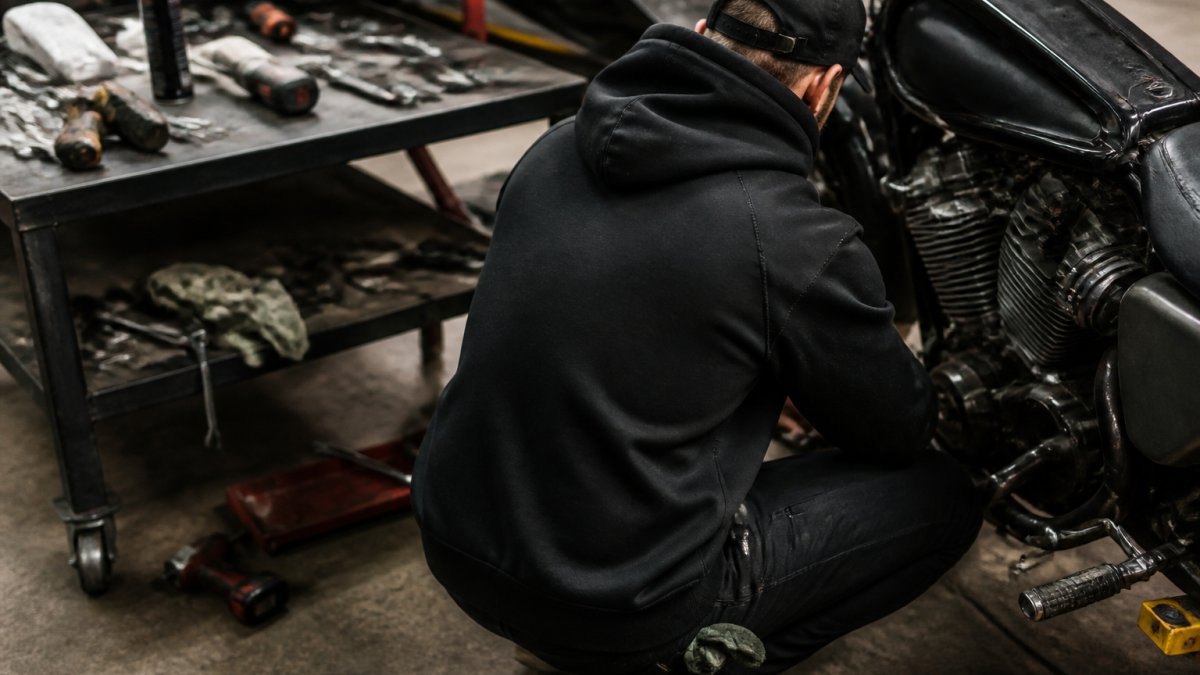
Pocket utility: what a mechanic actually needs to carry
A standard front pouch is a hand warmer, not a tool carrier: no closure, dividers, or reinforced corners, so a wrench or socket set shifts, pokes through, or falls out when you bend over. Keep tools in a belt or chest rig unless the hoodie has purpose-built storage.
When evaluating a hoodie for tool carry, look for:
- Kangaroo pouch depth and opening width. Too shallow and tools slide out when you crouch; too wide and they rattle.
- Interior divider or hidden pocket. Keeps a phone or pen from migrating to the pouch bottom.
- Zippered side pockets. The safest place for a phone, keys, or a small meter, and they keep debris out.
A practical pocket test before you buy
If the product page gives measurements, run this check:
- Phone test. Drop your phone in the pouch and bend forward. If it slides toward the opening, the pouch is too shallow for anything heavier.
- Tool test. Put a small wrench or screwdriver in the pouch and walk. If it swings and hits your leg, keep tools on a belt.
- Corner test. Visible bar tacks or a second row of stitching inside the pouch corners mean they are reinforced.
- Closure test. Zippered pockets should use a metal or heavy-duty nylon zipper, not a lightweight coil that fails under grit.
The BNF Motorworks Turbo Skull Back hoodie uses reinforced ribbed cuff and hem construction, a large front pouch pocket, and a tear-away label that will not scratch a collared shirt.
Safety Standards: Flame-Resistant and Hi-Vis Requirements for Technicians
Standard cotton-poly hoodies are neither flame-resistant nor high-visibility. If your workplace requires either, a regular hoodie does not meet the requirement no matter how heavy the fabric is. What matters is which standard, which class, and how to verify it on the label.
Flame-resistant (FR) garments use treated or inherently non-flammable fibers tested against recognized standards. High-visibility (Hi-Vis) garments use fluorescent fabric and reflective tape so moving vehicles and equipment can see you.
BNF Motorworks — Turbo Skull Back (Black Hoodie) →
The FR and Hi-Vis standards you will actually see on a label
You do not need to memorize every standard, but recognize the ones on North American and European workwear labels or spec sheets:
- NFPA 2112, the standard for flame-resistant garments for industrial personnel, and the reference most U.S. safety officers expect.
- NFPA 70E, the electrical safety standard defining arc-flash PPE categories (1 through 4). The category determines the required arc rating (ATPV or EBT, in cal/cm²), not fabric weight. A heavy hoodie with no arc rating is not PPE.
- ASTM F1506, the standard for flame-resistant clothing used by electrical workers, tied to the arc-rating requirement above.
A hoodie that says "flame-resistant fabric" with no standard number is a marketing claim, not certified PPE, same for "high-vis" without an ANSI/ISEA 107 or EN ISO 20471 class.
How to verify a claim before you buy
- Find the standard number on the label or product page. If it is not there, assume it is not certified.
- Check the arc rating if you work near energized equipment. The number is in cal/cm² and should match or exceed the category your employer's hazard assessment requires.
- Confirm the Hi-Vis class matches your environment. Class 2 for most shop and yard work near vehicles; Class 3 where speeds and traffic volumes are higher.
- Ask for the manufacturer's test documentation. Reputable FR and Hi-Vis suppliers provide it on request.
- Remember that FR performance degrades with the wrong care routine. Grease, solvents, or fabric softener can compromise FR fabric. Follow the garment's care instructions exactly, covered below.
What a standard heavy blend hoodie can and cannot do
| Requirement | What It Means | Can a Standard Hoodie Meet It? |
|---|---|---|
| Flame-resistant (FR) | Self-extinguishing fabric, tested to a recognized standard (e.g., NFPA 2112, ASTM F1506) | No |
| Arc-rated (NFPA 70E) | Fabric with a tested arc rating in cal/cm² | No |
| High-visibility (Hi-Vis) | Fluorescent color plus reflective tape, rated to ANSI/ISEA 107 or EN ISO 20471 | No |
| General garage work | No formal standard, comfort and durability only | Yes |
If your role involves welding, fuel systems, electrical work, or working near traffic, check your employer's written requirements and the applicable standard for your region before you buy. For general wrenching and detailing, a heavy blend hoodie is entirely appropriate, just do not mistake it for PPE it is not.
Layering Systems and Care for Heavy-Duty Hoodies
A layering system beats a single thick garment every time. Three thin layers trap more warm air and let you shed heat as the garage warms up.
Build it like this:
- Base layer: moisture-wicking synthetic tee against the skin.
- Mid layer: your heavy blend hoodie, 271 g/m² or similar.
- Outer layer: a wind-resistant shell or an FR jacket if the job requires it.
This also extends the hoodie's life, since it sits less directly against sweat and grime.
For care, follow the label: machine wash cold at 30°C, non-chlorine bleach only when needed, tumble dry medium, iron on low heat, do not dry clean.
Where to Buy Heavy Duty Mechanic Hoodies: Pricing and Bulk Orders
You can buy heavy duty mechanic hoodies directly from BNF Motorworks, with most styles at $47.99 and the Engine Breaker back print at $59.99.
Our pick for most people is the Skeleton Mechanic Back hoodie: original V-twin artwork, a small BNF mark on the chest, a sleeve ID, and the reinforced ribbed cuff and hem construction we recommend for garage wear.

For something louder, the Engine Breaker Back Print hoodie carries a large back print with a chest logo and sleeve graphics. It runs $59.99.
For car club matching gear, the Turbo Skull Crossed Wrenches hoodie and the Classic Sharknose Skull Back hoodie both work well as group designs, with embroidery available on either left chest, center chest, or large center chest, as well as right + left wrists.

Sizing runs S through 5XL. Measure a hoodie you own laid flat and compare width and length, allowing up to 1.5 inches tolerance.
Check current shipping and returns terms on each product page before ordering.
Frequently Asked Questions
What features should I look for in a heavy-duty mechanic hoodie?
Focus on fabric weight, reinforced stress points, and pocket utility. A 271 g/m² (8 oz) cotton-polyester blend like the Gildan 18500 used in BNF Motorworks hoodies balances warmth with breathability. Look for double-lined hoods, ribbed cuffs and hem to hold shape, and a front pouch pocket for tools. If you work near sparks or open flames, check for flame-resistant certification.
Are heavyweight hoodies better for cold garage environments?
Yes, within reason. A heavier fabric traps more body heat, which helps in unheated garages during winter. The 271 g/m² blend in BNF Motorworks hoodies provides warmth without the stiffness of ultra-heavy 600 GSM options. For extreme cold, layer a moisture-wicking base layer underneath.
Do mechanic hoodies need to be flame resistant?
It depends on your work environment. If you weld, grind metal, or work near open flames, flame-resistant (FR) hoodies are a safety requirement under most industrial safety standards. For general garage work like oil changes, brake jobs, or engine swaps, standard heavy-duty hoodies work fine. BNF Motorworks hoodies are not FR-rated, so they suit DIY mechanics, car show attendees, and hobbyists rather than industrial welders. Always check your employer's safety policy before assuming standard workwear is acceptable.
How do I maintain the durability of my mechanic hoodie?
Machine wash cold at a maximum of 30°C (90°F) and use non-chlorine bleach only when needed. Tumble dry on medium heat, then iron on low if required. Never dry clean a cotton-polyester blend hoodie because the chemicals break down the fabric fibers. Turn the hoodie inside out before washing to protect the print. Avoid fabric softener, which coats the fibers and reduces moisture-wicking performance. Following these steps keeps the shape, color, and print intact for years.
What is the difference between a standard hoodie and a work-grade hoodie?
Standard hoodies prioritize fashion with lighter fabrics and minimal reinforcement. Work-grade hoodies add durability features: heavier fabric (271 g/m² or more), reinforced seams at stress points, abrasion-resistant surfaces, and often utility pockets designed for tools. They also hold up better to repeated washing and harsh garage conditions. BNF Motorworks hoodies sit in the middle, offering heavy-duty construction with automotive-themed designs that work at car shows and in the garage. The 2-year EU warranty reflects that durability commitment.
Cheap hoodies fail because they are built for looks, not for a cold garage floor. Choosing the right fabric weight, fit, and layering system solves that, and BNF Motorworks builds every hoodie on the same 271 g/m² Heavy Blend blank with reinforced ribbed cuffs and hem, a double-lined hood, and original motor-inspired artwork. Choose BNF Motorworks and get gear that holds its shape through grease, cold, and repeated washes.