

Table of Contents
- Quick Comparison: Top Picks for Garage and Track
- What Makes the Best Graphic Tees for Mechanics?
- Top Graphic Tees for Mechanics: Reviews and Pricing
- Durable Mechanic Work Shirts: What to Look For in Stitching and Fit
- Best Fabric for Garage Workwear: Cotton Blend vs. Synthetic
- How to Care for Graphic Tees So They Last Through Washes
- Bulk Ordering for Car Clubs and Small Shops
- Conclusion: Choosing the Right Tee for Your Garage
- Frequently Asked Questions
Last Updated: September 27, 2026
Quick Comparison: Top Picks for Garage and Track
Finding the best graphic tees for mechanics comes down to one thing: the print survives longer than the shirt does. A design that looks sharp on day one can crack, fade, or peel within a dozen washes if the fabric underneath can't take punishment. This guide from BNF Motorworks breaks down what holds up in a working garage, from fabric weight to stitching to oil, grease, and laundering.
| Tee | Price | Fabric | Best For |
|---|---|---|---|
| Turbo Skull Crossed Wrenches Tee | $26.16 | 100% cotton, 5.3 oz/yd² | Best overall value |
| Fist & Piston Tee | $29.99 | Airlume combed ring-spun cotton, 4.2 oz/yd² | Best breathability |
| Turbo Skull Back Print Tee | $32.99 | Airlume combed ring-spun cotton, 4.2 oz/yd² | Best for car shows |
| Sharknose Rider Back (Black Tee) | $37.80 | Airlume combed ring-spun cotton, 4.2 oz/yd² | Best premium option |
What Makes the Best Graphic Tees for Mechanics?
A mechanic's tee has to do two jobs: survive the shop and still look right at a Saturday meet. Many novelty shirts fail because they're built for a photo, not for leaning over a fender with a wrench in hand.

Fabric Performance Testing: What Holds Up to Oil and Grease
Print durability under shop conditions is the factor most buyers overlook. A graphic tee for mechanics faces oil splatter, grease smudges, and constant abrasion against tools and engine bays.
Safety Compliance in Apparel: What to Look For
Safety compliance in apparel means checking whether a garment meets recognized textile safety and testing standards, not just whether it looks tough. For shop wear, the marker is third-party certification.
Top Graphic Tees for Mechanics: Reviews and Pricing
Every pick below comes from the BNF Motorworks lineup, priced as listed, with the fabric specs that matter for shop and show use.
1. Turbo Skull Crossed Wrenches Tee: Best Overall Value
At $26.16, this is the best value in the lineup. It's built on the Gildan 5000, a 100% cotton, 5.3 oz/yd² heavy tee with a classic fit and crew neckline.
2. BNF Motorworks, Fist & Piston Tee: Best for Breathability
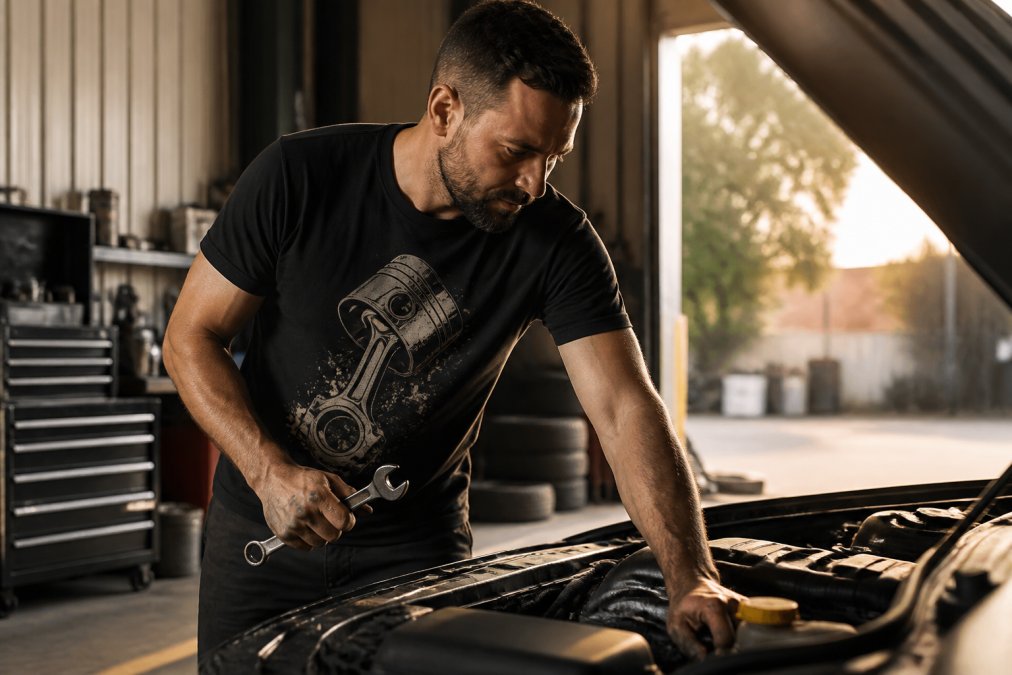
If you work in a hot shop, the Fist & Piston Tee is the pick. It's a Bella+Canvas 3001 jersey tee at 4.2 oz/yd², made from Airlume combed and ring-spun cotton with a ribbed crew neck and side seams, priced at $29.99.
3. BNF Motorworks, Turbo Skull Back Print Tee: Best for Car Shows
For show days, the back print is the whole point. This tee runs $32.99 on the Bella+Canvas 3001, with the Turbo Skull design across the back where it reads best in a crowd.
4. BNF Motorworks, Sharknose Rider Back (Black Tee): Best Premium Option
The top of the range at $37.80, the Sharknose Rider Back is for the buyer who wants the most detailed back graphic. Same Bella+Canvas 3001 base: 4.2 oz/yd², Airlume combed ring-spun cotton, retail fit, tear-away label.
Durable Mechanic Work Shirts: What to Look For in Stitching and Fit
Durable mechanic work shirts share three construction details: reinforced shoulder seams, side seams that hold shape, and a collar that doesn't stretch out. Those three points decide whether a tee survives a season or a few washes.
Best Fabric for Garage Workwear: Cotton Blend vs. Synthetic
Most guides stop at "cotton breathes, synthetics wick", fine for a weekend car show, useless for a mechanic leaning over a hot engine eight hours a day. The real question is how each fiber behaves under three shop stressors: heat and sparks, oil and grease, and abrasion against tools and sheet metal.
- 100% cotton, mid-weight (5.3 oz/yd², Gildan 5000 class): The default for shop wear. Cotton chars rather than melts when exposed to sparks, making it the safer base layer around grinders and welding spatter, and the tighter knit grips ink for sharp screen prints. The trade-off is moisture: it soaks sweat and dries slowly, so a heavy tee gets clammy under a hood in July.
- Ring-spun cotton, lightweight (4.2 oz/yd², Bella+Canvas 3001 class): Softer and more breathable, with a smoother surface that takes fine print detail well. It wicks marginally better than heavy cotton but abrades faster against fender edges and tool handles. Best for show days, mild weather, and layering under a shop jacket.
- Cotton-poly blends (heather colorways): Polyester adds stretch and pulls moisture off the skin faster than pure cotton, which helps in humid shops. The catch is heat behavior, synthetics can melt and stick to skin if exposed to sparks or welding spatter, so blends are a poor choice for hot work. Print crispness also drops slightly because poly fibers don't absorb ink like cotton.
- Performance synthetics (polyester/spandex wicking knits): These move sweat fastest and dry in minutes, but they hold oil and grease stains more stubbornly than cotton, snag on sharp edges, and carry the same melt risk around sparks. Fine for a detailing bay or parts counter; not under a lift with a grinder nearby.
A few practical notes most fabric guides skip:
- Oil and grease resistance is a finish, not a fiber property. No standard cotton or cotton-blend graphic tee is inherently oil-resistant. If stain release matters more than breathability, look for a soil-release finish, or treat shop tees as consumables and rotate them. Dark heather and black hide grease smudges far better than white or light gray, which is why most working mechanics default to dark shirts.
- Moisture-wicking matters most under layers. Under coveralls or a shop jacket, a wicking base layer keeps you drier than cotton. If the tee is your outermost layer, breathability and airflow matter more than wicking chemistry.
- Snag resistance is a knit-density question, not a fiber question. A tighter knit, heavier cotton, higher yarn count, resists snags from tool edges and sharp sheet metal better than a loose, thin weave, regardless of fiber content.
How to Care for Graphic Tees So They Last Through Washes
Caring for graphic tees comes down to temperature and drying method. Heat kills prints and shrinks cotton, so control both.
- Wash cold, at 30°C (90°F) or below, to protect the print and limit shrinkage.
- Turn the shirt inside out to reduce abrasion on the graphic.
- Use non-chlorine bleach only, and skip fabric softener, which can break down print adhesion over time.
- Tumble dry on low heat, or air dry to extend both fabric and print life.
- Do not iron the print, and do not dry clean.
Bulk Ordering for Car Clubs and Small Shops
Most bulk-ordering advice targets 100+ unit orders. A small shop with six techs and a service writer has a different problem: higher per-unit prices, tighter minimums, and one wrong size decision leaving someone with an unwearable shirt. Here's how to run a 5-20 person order without the headaches.
Step 1: Pick the blank before you pick the design
The blank decides everything downstream, print quality, durability, and how the shirt feels after fifty washes. Standardize on one mid-weight 100% cotton blank (a 5.3 oz/yd² Gildan 5000 class tee) for daily wear, and optionally one lighter ring-spun blank (Bella+Canvas 3001 class) for front-counter staff and show days. Mixing three or four blanks usually means inconsistent sizing and print results.
Step 2: Collect sizes with a real fit reference, not a guess
"Medium" means different things across blanks. Circulate one physical sample in the most common size and have everyone try it on before committing. If that's not possible, ask for chest measurements and compare against the blank's published size chart, not the size they wear in another brand. Order two extra units in the two most common sizes for late hires and replacements.
Step 3: Choose a print method that matches the design
A common pattern for small shops is embroidery on the front chest and a screen-printed back graphic, which balances durability and visual impact.
Step 4: Confirm colorways and print contrast before the run
Print contrast varies by shirt color: a white graphic on black reads sharp, but the same white on light heather gray looks washed out. If the shop runs multiple colorways, request a digital mockup on each before approving. Dark colorways also hide grease and oil smudges better in the bay.
Step 5: Set up reorders before you need them
For a car club, the same steps apply, but the design usually leans toward a club logo or event graphic. The sizing and reorder discipline is what separates a smooth order from a box of unwearable shirts.
Conclusion: Choosing the Right Tee for Your Garage
The right tee for your garage balances durability, comfort, and how you use it. Under a hood most days, the Turbo Skull Crossed Wrenches Tee at $26.16 gives the best value and toughest knit. If breathability matters more, the Fist & Piston Tee at $29.99 is the lighter, cooler pick. For show days, the Turbo Skull and Sharknose back prints put the design where people see it.

Frequently Asked Questions
Who makes the highest quality graphic tees?
The highest quality graphic tees use tightly knit cotton or cotton blends that hold up to repeated washing. Look for brands that specify fabric weight (like 5.3 oz/yd² or 4.2 oz/yd²) and offer certifications such as OEKO-TEX STANDARD 100. BNF Motorworks uses Gildan 5000 and Bella+Canvas 3001 blanks, both known for durability and print longevity. Reinforced shoulders and seamless construction are also signs of better quality.
Are graphic tees durable enough for daily garage work?
Yes, if you choose the right fabric. Medium-weight 100% cotton tees like the Gildan 5000 (5.3 oz/yd²) resist wear and hold their shape through repeated washes. Lighter ring-spun options like the Bella+Canvas 3001 (4.2 oz/yd²) are breathable and comfortable for long shifts. Avoid thin, poorly stitched shirts. Reinforced shoulders and side seams make a big difference in how long a tee lasts in a garage environment.
What are the best fabrics for mechanic work shirts?
For garage work, 100% cotton or cotton-poly blends work best. Cotton is breathable, holds up to oil and grease, and doesn't melt near heat like some synthetics. Medium-weight cotton (5.3 oz/yd²) offers a good balance of durability and comfort. Ring-spun cotton feels softer but may be slightly lighter. For stain-hiding, choose darker colors like charcoal gray or rust tones over white.
How to choose a mechanic t-shirt that balances style and comfort?
Start with fabric weight and fit. A classic or retail fit in medium-weight cotton gives you room to move without looking sloppy. Look for automotive-themed designs that match your interests, like tool graphics or piston art. For comfort, check for tear-away labels and breathable fabrics. BNF Motorworks offers several options from $26.16 to $37.80, each with different fits and designs suited to garage work or car shows.
Should mechanics wear cotton or synthetic blends for work?
Cotton is generally better for garage work because it's breathable, handles oil stains well, and won't melt if exposed to sparks or heat. Synthetic blends dry faster and resist wrinkles, but they can hold onto grease and may be less comfortable in hot shops. If you want the best of both, look for a cotton-poly blend like the Bella+Canvas 3001 heather options, which mix 52% cotton and 48% polyester for added durability.
Picking a tee that survives the shop and still looks right at a show shouldn't be a guessing game. BNF Motorworks builds automotive-themed apparel on durable blanks like the Gildan 5000 and Bella+Canvas 3001, with designs including the Fist & Piston series and the Turbo Skull back prints. Choose BNF Motorworks for gear that holds up to oil, grease, and a full season of washes, then wear it with the same confidence you bring to the bay.